
Offshore vs Onshore Drilling: 7 Critical Economic & Environmental Insights

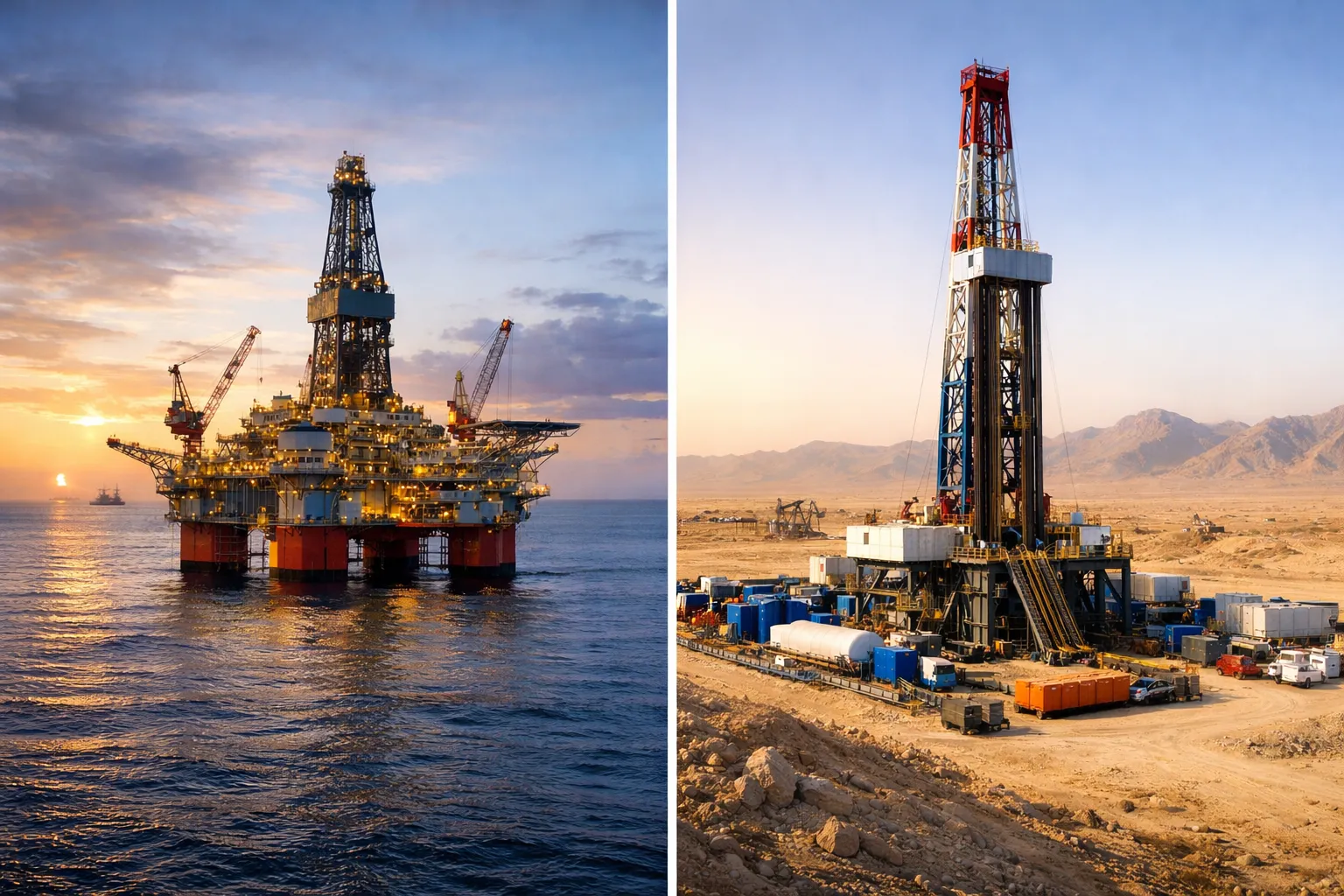
For upstream decision-makers, procurement managers, and global energy traders, understanding offshore drilling versus onshore drilling is essential to optimizing sourcing strategies, managing risk, and aligning with evolving environmental compliance standards. Both extraction models drive significant portions of global crude supply — yet they differ sharply in capital requirements, operational complexity, regulatory exposure, and ecological footprint. This article delivers a structured, data-informed comparison built for B2B professionals operating in today’s competitive energy markets.
Table of Contents
1. Market Context: Why This Comparison Matters
Global crude oil supply depends on both offshore drilling and onshore production assets. According to the U.S. Energy Information Administration (EIA), offshore fields account for roughly 30% of total global oil output. As energy transition pressures increase and ESG compliance requirements tighten, understanding the structural differences between these two extraction models directly affects trade positioning and supply reliability.
Traders sourcing crude under HS Code 2709.00 must evaluate not only price but also production origin, extraction method, and associated risk factors. The choice between offshore and onshore supply sources has long-term implications for contract stability and price benchmarking against Brent, WTI, and Dubai crude markers. For a deeper look at how crude benchmarks affect sourcing decisions, refer to our guide on WTI vs Brent vs Dubai oil benchmarks.
2. Capital Costs and Investment Scale
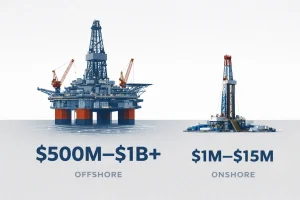
Offshore drilling demands significantly higher upfront capital investment than onshore operations. Deepwater platforms can require $500 million to over $1 billion per installation. Floating production storage and offloading (FPSO) units, subsea wellheads, and dynamic positioning systems all compound initial CAPEX substantially.
Onshore drilling, by contrast, typically ranges from $1 million to $15 million per well depending on depth, geography, and reservoir complexity. Shale and tight oil plays in North America have further compressed onshore CAPEX through pad drilling and efficiency improvements. For B2B buyers, lower onshore CAPEX generally means faster production ramp-up and more flexible supply scheduling.
3. Operating Costs and Break-Even Analysis
Operating costs tell a similarly divergent story. Offshore drilling operations typically carry OPEX of $20–$50 per barrel for deepwater assets, while ultra-deepwater fields can exceed $60 per barrel. Crew rotation, marine logistics, subsea maintenance, and corrosion management all drive costs higher in offshore environments.
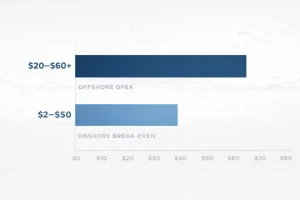
Onshore assets — particularly Middle Eastern conventional fields — can operate at break-even costs as low as $2–$10 per barrel. U.S. shale producers operate at $30–$50 per barrel after accounting for well completion and midstream fees. From a supply chain perspective, onshore production generally offers greater cost predictability and more responsive output adjustments aligned with market demand signals.
4. Environmental Impact and Regulatory Compliance
Environmental risk profiles differ significantly between extraction models. Offshore drilling carries the risk of large-scale marine spills, with incidents like Deepwater Horizon demonstrating catastrophic liability exposure. Regulatory frameworks such as MARPOL, OSPAR, and national offshore safety codes impose stringent containment and emergency response requirements.
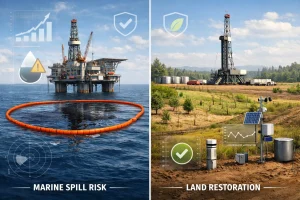
Onshore drilling presents different environmental challenges — groundwater contamination, land degradation, and fugitive methane emissions are primary concerns, especially in hydraulic fracturing operations. However, onshore spill containment is generally more manageable and remediation costs are lower relative to offshore incidents. ESG-conscious buyers and institutional investors increasingly scrutinize the environmental credentials of upstream supply sources during due diligence.
5. Supply Chain and Logistics Complexity
Offshore drilling operations require sophisticated marine logistics networks — supply vessels, helicopter transport, subsea pipeline infrastructure, and offshore terminal connectivity. Weather disruptions, port congestion, and marine traffic can introduce significant delivery variability for downstream buyers and refiners.
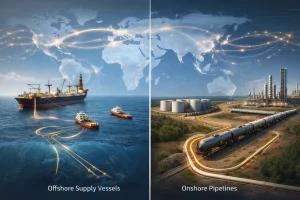
Onshore production benefits from established pipeline networks, road and rail transport, and proximity to refinery complexes in major producing regions. This translates into more predictable lead times and lower freight cost volatility. Supply chain managers sourcing crude for refinery feedstock planning generally find onshore-origin barrels easier to schedule within just-in-time procurement frameworks.
6. Head-to-Head Comparison Table
| Factor | Offshore Drilling | Onshore Drilling |
|---|---|---|
| CAPEX per Well | $500M – $1B+ | $1M – $15M |
| OPEX per Barrel | $20 – $60+ | $2 – $50 |
| Environmental Risk | High (marine spills) | Moderate (land/water) |
| Supply Flexibility | Low – High lead times | High – Faster adjustment |
| Logistics Complexity | Very High | Moderate |
| ESG Scrutiny Level | Very High | High |
| Crude Output Volume | Large deepwater reserves | Variable by region |
7. Strategic Outlook for Global Buyers
The strategic importance of offshore drilling remains high for long-term global supply capacity, particularly as easily accessible onshore reserves mature in key producing nations. However, buyers must weigh the cost premium, longer project timelines, and elevated environmental liability of offshore assets against the supply reliability advantages they provide.
Key considerations for B2B procurement teams include:
- Break-even price thresholds relative to current Brent benchmarks and contract structures
- ESG compliance requirements under institutional procurement policies and investor mandates
- Supply chain resilience — evaluating single-source offshore dependency versus diversified onshore portfolios
- Regulatory exposure in the country of extraction, particularly for offshore jurisdictions with evolving liability frameworks
- Long-term volume commitments versus short-term spot market flexibility from onshore producers

Understanding how these upstream factors influence downstream product specifications and refinery economics is equally important. For an expanded perspective on petroleum products and their global trade dynamics, explore our overview of petroleum products driving global industrial growth.
Conclusion
Both offshore drilling and onshore drilling play indispensable roles in sustaining global crude supply. Offshore assets deliver large-volume, deepwater reserves critical to long-term energy security, while onshore production offers cost efficiency, supply flexibility, and lower logistical complexity. For global traders, importers, and supply chain managers, the optimal sourcing strategy demands a nuanced evaluation of CAPEX, OPEX, environmental liability, and market responsiveness across both extraction models.
As regulatory frameworks tighten and ESG accountability increases, aligning upstream sourcing decisions with both commercial objectives and environmental standards has never been more critical for sustainable B2B energy procurement.
Partner with Petro Eghlima for Reliable Upstream Crude Sourcing
Whether your procurement strategy relies on offshore drilling origins or onshore-produced crude, Petro Eghlima delivers verified supply, competitive pricing, and full documentation support for international B2B buyers. Our team provides FOB, CIF, and DAP terms tailored to your trade requirements.
We are ready to engage with genuine and loyal buyers.
Contact us at petroeghlima.com to discuss specifications, volumes, and supply schedules with our senior trading team.